What Does William Henry Harrison Have to Do With Prophetstown
The Battle of Tippecanoe ( TIP-ee-kə-NOO ) was fought on November 7, 1811, in Battle Footing, Indiana between American forces led past then Governor William Henry Harrison of the Indiana Territory and Native American forces associated with Shawnee leader Tecumseh and his brother Tenskwatawa (commonly known as "The Prophet"), leaders of a confederacy of various tribes who opposed European-American settlement of the American frontier. Equally tensions and violence increased, Governor Harrison marched with an army of nigh 1,000 men to attack the confederacy's headquarters at Prophetstown, almost the confluence of the Tippecanoe River and the Wabash River.
Tecumseh was not even so ready to oppose the United States past force and was away recruiting allies when Harrison's army arrived. Tenskwatawa was a spiritual leader but not a military man, and he was in accuse. Harrison camped near Prophetstown on November 6 and arranged to meet with Tenskwatawa the following day. Early on the next morning warriors from Prophetstown attacked Harrison's army. They took the army by surprise, just Harrison and his men stood their footing for more than two hours. Later on the battle, Harrison'southward men burned Prophetstown to the ground, destroying the food supplies stored for the winter. The soldiers so returned to their homes.
Harrison accomplished his goal of destroying Prophetstown. The win proved decisive and garnered Harrison the nickname of "Tippecanoe". Meanwhile, the defeat dealt a fatal blow for Tecumseh's confederacy and, though comeback attempts were made, information technology never fully recovered.[two] [3] So pop was Harrison'southward nickname that the Whigs turned "Tippecanoe and Tyler besides" into the slogan and a popular song for Harrison and his running mate John Tyler's 1840 presidential campaign.
Background [edit]
William Henry Harrison was appointed governor of the newly formed Indiana Territory in 1800, and he sought to secure title to the area for settlement.[4] He negotiated land cession treaties with the Miami, Pottawatomie, Lenape, and other tribes in which 3 meg acres (approximately 12,000 km2) were acquired by the The states at the Treaty of Fort Wayne,[5] the second of such treaties afterwards the earlier treaty of 1803.[6]
The leader of the Shawnee, Tecumseh, opposed the 1809 Treaty of Fort Wayne.[6] He believed that state was owned in common by all tribes; therefore specific parcels of lands could not exist sold without full agreement from all the tribes.[7] The previous generation Mohawk leader Joseph Brant advocated a similar philosophy and called for unification of tribes.[eight] Tecumseh's younger brother Tenskwatawa, known as the Prophet, was a spiritual leader amongst the northwestern tribes, advocating for a render to traditional ancestral ways.[9] [10] Though Tecumseh resisted the 1809 treaty, he was reluctant to face up the U.s.a. directly. He traveled through tribal lands, urging warriors to abandon their chiefs to join his endeavour, threatening to kill chiefs and warriors who adhered to the terms of the treaty, edifice a resistance at Prophetstown.[7] [viii]
Prelude [edit]
In 1810, Tecumseh and Governor Harrison met at Grouseland (Harrison'south Vincennes home). Tecumseh demanded nullification of the treaty and the lands returned to the tribes. Harrison insisted each tribe had individual and separate arrangements with the United states of america, ridiculing the idea of common ownership of lands.[11] Tecumseh stated his position conspicuously: he would serve the American loyally if the lands were returned; if non he would seek an alliance with the British.[12] As early as 1810, British agents had sought to secure an brotherhood with Tecumseh,[13] who was reluctant to marry with them considering he recognized that they used the tribes to fight their wars on the borderland.[11] Nonetheless he travelled to Canada to meet with the British and Canadians in November 1810, after securing alliances with the Potawatomi and the Odawa besides as contacting the Iowa.[14]

Tecumseh by Benson Lossing in 1848, based on an 1808 cartoon


In the following year, Harrison blamed the Shawnee for the murder of a scattering of men on the frontier and for the theft of a boatload of salt,[xv] but more than importantly sent a stream of letters to Washington requesting permission to move against them. He wrote, "In Indian warfare there is no security just in offensive measures."[16] He summoned Tecumseh to a meeting in the summer of 1811.[fifteen] As before, Tecumseh presented himself equally an eloquent speaker merely the meeting proved unproductive.[16] Tecumseh informed Harrison he was leaving to recruit among the Muscogee and Choctaws and asked to wait upon his return to commence settlement on the disputed lands.[17] He said he wanted "no mischief" during his absence, a plea he fabricated to Harrison and Tenskwatawa.[18]
Tenskwatawa stayed with the Shawnee who were camped at the Tippecanoe in Prophetstown, a settlement that had grown to a few hundred structures and a sizable population.[xviii] Harrison believed military strength the only solution towards militant tribes. Secretary of War William Eustis sent orders to preserve peace with the Native Americans, but went on to say, "but if the Prophet should commence, or seriously threaten, hostilities he ought to exist attacked."[16] Harrison sent a series of messages to Tenskwatawa with a number of demands. He defendant Tenskwatawa's followers of murdering whites in Illinois (almost certainly the piece of work of Main Poc and his Potawatomi); ordered not-Shawnee residents banned from Prophetstown; and accused the Shawnee of equus caballus theft. Tenskwatawa replied that the horses would be returned but failed to address the other demands.[19] Harrison started raising troops. Nigh 400 militia came from Indiana and 120 cavalry volunteers from Kentucky, led by Kentucky's U.S Commune Chaser Joseph Hamilton Daveiss. There were 300 Army regulars commanded by Col. John Parker Boyd, and additional native scouts. All told he had an about 1,000 troops.[20]
Harrison gathered the scattered militia companies at Fort Knox[a] north of Vincennes.[21] They reached Terre Haute, Indiana where they camped and built Fort Harrison.[22] The month of October was spent constructing the fort, resupplying and preparation the troops. The Shawnee captured a group of Delaware chiefs traveling to Harrison, who had asked them to human activity as negotiators; after their release they arrived at the end of October with accounts of various aggressive deportment. When a guard was shot outside the fort, Harrison considered it an aggressive action and reason for of military retaliation against Prophetstown. He wrote to Eustis: "Nothing now remains but to chastise him [Tenskwatawa] and he shall certainly get it.[23]
Boxing [edit]
Harrison's forces approached Prophetstown on November 6. He was to come across the next twenty-four hour period with Tenskwatawa but believed negotiation futile. They made campsite on Burnett's Creek, (Battleground, Indiana); the troops bedded down fully dressed and armed, based on Harrison's Aide-de-camp Bartholomew's advice.[24]

Positioned in pickets according to boxing lines, they kept blazing fires alight in the rain, which illuminated the army camp. Harrison did not command fortifications erected.[25] The perimeter was guarded by 2 companies of sentries.[24] Captain Spier Spencer's Indiana Yellow Jacket riflemen, (known for their light-colored buckskins),[26] was posted on the southern cease of the camp perimeter. The rest of the militia established an irregular rectangular germination along the edges of the bluff surrounding the camp.[24] Lieutenant Colonel Joseph Bartholomew allowable all infantry units guarding the front end line.[27] The regulars and dragoons were kept in reserve backside the primary line, commanded past Major Floyd, Major Daveiss,[28] and one-time congressman Captain Benjamin Parke.[26]
Tenskwatawa told Michigan Governor Lewis Cass in 1816 that he did not order his warriors to set on Harrison, and he blamed the Ho-Clamper (Winnebago) warriors in his camp for launching the attack. Not long after the boxing a Kickapoo chief told British Indian agent Matthew Elliot, that the shooting of two Winnebago warriors past the sentries "angry the indignation of the Indians and they determined to be revenged and accordingly commenced the set on."[29] Tenskwatawa's followers were worried by the nearby army and feared an imminent attack. They had begun to fortify the town but had not completed their defenses.[30] In council the nighttime of November 6, Tenskwatawa seems to have agreed to a preemptive strike against the Americans, and to sending in a party nether the embrace of nighttime to murder Harrison in his tent.[31] He assured the warriors that he would bandage spells to foreclose them from beingness harmed and to crusade confusion among Harrison's army and so that they would not resist. The warriors began to environment Harrison's army, looking for a way to enter the camp undetected.[25] A human being named Ben was a wagon driver traveling with Harrison's army, and he had deserted to the Shawnees during the expedition. He agreed to lead a grouping of warriors through the line to Harrison's tent during the late night hours, but he was captured by the camp sentries, taken back to campsite, and bound. He was after convicted of treason, but Harrison pardoned him.[30]

Prophet's Rock nigh the Tippecanoe battleground most 1902. Tenskwatawa is idea to have sung or chanted from this rock to exhort his warriors against Harrison's forces.[32]
Accounts are unclear well-nigh how the battle began, but Harrison'due south sentinels encountered advancing warriors in the pre-dawn hours of November 7. Lieutenant Colonel Joseph Bartholomew was officeholder of the day, and he had ordered the troops to sleep with their weapons loaded. Effectually 4:30 a.m., the soldiers awoke to scattered gunshots,[33] and establish that they were nearly encircled past Tenskwatawa'southward forces.[28] Contact was first fabricated on the left flank of the perimeter, and then to the front end of the camp, the right flank and the rear. Helm Robert Barton's regulars and Captain Frederick Geiger's Kentucky militia faced firsthand vehement attacks and were unable to hold their line. Harrison replaced them with the Indiana militia, commanded by Lieutenant Peters – their commander Wentworth died in the first assault. Harrison found the front line under burn (facing Prophetstown), pressed by warriors with rifles situated in a grove of trees. The Americans held their position every bit the attacks continued, the regulars reinforcing that critical department of the line.[28] The militia's small-caliber rifles had footling event on the warriors as they rushed the defenders.[27]
White Loon and Rock Eater were Tenskwatawa'southward war chiefs. The Prophet situated himself on a small hill overlooking the battle. The element of surprise was lost at the start of the battle, forcing the warriors to assail in a disorganized and uncoordinated fashion, with numerous small assaults. They reorganized and rushed the Americans whenever Harrison'southward troops drove them off. Meanwhile, warriors with rifles crawled on their stomachs from the woods towards the line.[34]
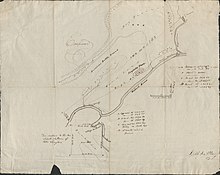
A map included in the Treaty of Prophetstown and Site of Boxing of Tippecanoe, 1819
On the northern end of the camp, Major Daveiss led the dragoons on a counter-charge. Most of Daveiss' visitor after retreated to Harrison's principal line following the charge, but Daveiss was killed.[28] The grove was cleared by the 4th regiment regulars.[28] To the rear, the assail was the strongest. The Indiana Yellow Jackets were nether heavy fire, unable to hold their line, their commander, Helm Spencer, dead.[28] His death is documented in Harrison's November 18, 1811 dispatch to Eustis: "Spencer was wounded in the head. He exhorted his men to fight valiantly. He was shot through both thighs and fell; still continuing to encourage them, he was raised upwardly, and received a brawl through his body, which put an immediate end to his existence."[35] Harrison moved two reserve companies under the control of Captain Robb to join Spencer'southward only living officeholder, ensign John Tipton, and they sealed the breach in the line.[36] Throughout the side by side 60 minutes, Harrison's troops fought off several more charges. The warriors began to run low on armament; the rising sunday revealed the dwindling size of Tenskwatawa'due south forces who quickly dispersed into the woods. Harrison's troops pursued. They discovered the bodies of 36 warriors in the forest, scalping them.[37]
The battle lasted about two hours and Harrison sustained 188 casualties: 37 died in action, 25 were mortally wounded. Another 126 sustained less serious wounds.[38] The Yellow Jackets suffered the highest casualties of the battle, with all just one officer killed.[39] The number of Native American casualties is nonetheless the subject of debate, but it was certainly lower than that of the American forces. Historians judge that as many as 50 were killed and about 70 to lxxx were wounded.[33] [37] The warriors retreated to Prophetstown where, according to one main'south account, they confronted Tenskwatawa, accusing him of cant because of the many deaths, which his spells were supposed to have prevented. He blamed his wife for desecrating his magic medicine and offered to cast a new spell; he insisted that the warriors launch a second assault, but they refused.[29]
The following day, November 8, Harrison sent a minor group of men to inspect the Shawnee town and establish information technology was deserted except for one elderly woman too sick to flee. The remainder of the defeated villagers had evacuated during the night. Harrison ordered the village burned, including 5,000 bushels of corn and beans in the storehouse.[37] Furthermore he had the village cemetery dug up, with corpses left strewn almost.[40] Later on Harrison'south troops departed the area, the villagers returned, digging upwardly many of the American corpses and handful the bodies in retaliation.[41]
Aftermath [edit]
The solar day after the battle, the American wounded were loaded onto wagons and brought back to Vincennes.[42] They arrived at Fort Harrison about vi days later. They boarded boats for the return to Vincennes on the river, arriving on November 18, at which point the militia was released home.[43] Harrison informed Eustis of a boxing well-nigh the Tippecanoe River, giving extensive details.[44] Eustis replied with a notation demanding to know why Harrison had non taken adequate precautions in fortifying his army camp. Harrison replied that he had considered the position strong enough without fortification.[45]

Document released to the public after the battle, containing messages from Harrison.
At first, newspapers carried footling information virtually the battle, every bit they were focused on the highlights of the on-going Napoleonic Wars in Europe. An Ohio newspaper printed a re-create of dispatches from Kentucky and characterized the battle equally a defeat for the The states.[46] Shocked at the loss of Daveiss, well-known and liked, Kentucky papers criticized Harrison and ane ran a front folio lament for Daveiss. When the story was picked upwards in the eastward it was disquisitional of Harrison, the Long Island Star writing, "Governor Harrison'south account with the Indians, in general, is non very satisfying."[47]
Historians have long believed that Tecumseh was furious with Tenskwatawa for losing the battle, and that Tecumseh had threatened to kill his brother for making the attack. Tenskwatawa lost prestige after the battle and no longer served every bit a leader of the confederacy. In their subsequent meetings with Harrison, several Native Americans leaders claimed that Tenskwatawa's influence was destroyed; some accounts said that he was beingness persecuted past other leaders. The situation was more nuanced according to historians Alfred A. Cave and Robert Owens who explicate the Native Americans were trying to mislead Harrison in an attempt to calm the state of affairs, and that Tenskwatawa continued to play an of import part in the confederacy.[48] [forty]
Harrison claimed that he had won a decisive victory, but some mod historians raise doubts. "In none of the [contemporaneous] reports from Indian agents, traders, and public officials on the aftermath of Tippecanoe can we observe confirmation of the claim that Harrison had won a decisive victory", according to Alfred Cave.[49] The defeat was a setback for Tecumseh's confederacy, although they rebuilt Prophetstown, and native violence increased on the frontier after the battle.[50] Adam Jortner says that the battle was a disaster for both sides, except in strengthening Tenskwatawa'south religious movement.[41]

Historical marker at the site of where the Boxing of Tippecanoe took place
On Dec 16, 1811, the first of the New Madrid earthquakes shook the South and the Midwest. Many tribes took the earthquake as a vindication of Tenskwatawa'due south powers, seeing as a "phone call to action".[47] They increased their attacks confronting American settlers and against isolated outposts in Indiana and the Illinois Territory, resulting in the deaths of many civilians.[51] Tecumseh connected to play a major office in military operations on the frontier. By the time that the U.S. alleged state of war on United kingdom of great britain and northern ireland in the War of 1812, Tecumseh'south confederacy was ready to launch its ain state of war against the U.s.a. – this time with the British in open alliance.[52]
The Shawnee partially rebuilt Prophetstown over the next year.[53] Tecumseh continued to play a major function in military operations on the frontier.[47] His warriors were with British forces that captured Fort Detroit from the The states in the War of 1812, and it was not until Tecumseh'due south death at the Battle of the Thames in 1813 that his confederacy ceased to threaten the Americans.[52]
"Tippecanoe and Tyler too" became the slogan and a popular song for Harrison and his running mate John Tyler in the 1840 presidential entrada. The Whigs leveraged Harrison's successes, using the song as a slogan and reminder of the battle.[54]
Memorial [edit]

Monument near the battle site
The participants in the battle received the Thank you of Congress. The resolution originally included William Henry Harrison by name, but his name was removed before passage. Harrison considered this to be an insult, thinking that Congress implied that he was the one person in the campaign non worthy of accolades, and he suggested that it held him up to obloquy and disrespect.[55] After Tippecanoe, Boyd'southward vocal criticism caused controversy. He said without the presence of the regulars, the militia would accept been routed, and he questioned Harrison'due south fitness as commander.[56] [57] Harrison was, notwithstanding, awarded the Thanks of Congress and a Congressional Gilded Medal in 1818 for victory at the Battle of the Thames.[58] A number of counties in Indiana were named for American soldiers at the battle: Bartholomew, Daveiss, Spencer, Tipton and Warrick.[59]
It shall exist the duty of the Full general Assembly,
to provide for the permanent enclosure and
preservation of the Tippecanoe Battle-ground.[60]
Harrison returned to the battlefield in 1835 to give speeches during his first presidential campaign, and he chosen for the cosmos of a memorial to preserve the battle site. John Tipton later purchased the land to preserve information technology and deeded it to the state on November seven, 1836 which was the twenty-5th anniversary of the battle. [61]
In 1908, the Indiana General Assembly deputed an obelisk memorial at the battleground that was lxxx-pes (24 m) high. On Oct 9, 1960, the Tippecanoe Battlefield was named a national celebrated landmark.[62] In 1961, some 10,000 people attended the 150th anniversary of the battle.[63]
In the post-obit years, the battle site attracted fewer visitors and fell into disrepair, and the Tippecanoe Canton Historical Clan now maintains the battlefield and housing a museum about the battle.[63]
Notes [edit]
- ^ "Fort Knox II", not Fort Knox in Kentucky
References [edit]
- ^ Sugden, facing 211.
- ^ Blaine T. Brownell; Robert C. Cottrell (2010). Lives and Times: Individuals and Issues in American History: To 1877. Rowman & Littlefield. p. 130. ISBN9781442205581.
- ^ Spencer C. Tucker (2014). Battles That Changed American History: 100 of the Greatest Victories and Defeats. ABC-CLIO. p. 83. ISBN9781440828621.
- ^ Tunnell, p. xiii
- ^ Owens, p. 206
- ^ a b Owens, p. xxiv
- ^ a b Owens, p. 212
- ^ a b Langguth, pp. 164–65
- ^ Langguth, pp. 158–ix
- ^ Owens, p. 211
- ^ a b Langguth, pp. 165–66
- ^ Langguth, p. 166
- ^ Langguth, p. 164
- ^ Jornter, p. 177
- ^ a b Langguth, p. 167
- ^ a b c Jornter, p. 183
- ^ Jornter, p. 184
- ^ a b Owens, p. 213
- ^ Cave, pp. 116–118
- ^ Owens, pp. 214–xv
- ^ "Fort Knox Ii". Indiana State Museum. 2009. Archived from the original on 2011-08-18. Retrieved 2011-05-07 .
- ^ Owens, p. 216
- ^ Tunnell, pp. 39–forty
- ^ a b c Tunnell, p. 61
- ^ a b Owen, p. 217
- ^ a b Tunnell, p. 148
- ^ a b Tunnell, p. 73
- ^ a b c d e f Tunnell, p. 65
- ^ a b Cave, p. 120–21
- ^ a b Owens, p. 219
- ^ Cavern, p. 119
- ^ Tucker, vol. i, p. 786, col. 2.
- ^ a b Owen, p. 218
- ^ Tunnell, p. 67
- ^ Dillon, p. 471.
- ^ Tunnell, p. 66
- ^ a b c Langguth, p. 169
- ^ Tunnell, p. 134
- ^ Tunnell, p. 99
- ^ a b Cave, p. 122
- ^ a b Jortner, p. 196
- ^ Tunnell, p. 175
- ^ Pirtle, pp. 76–77
- ^ Dillon, pp. 466–71
- ^ Owens, pp. 219–220
- ^ Owens, p. 220
- ^ a b c Jortner, p. 199
- ^ Owens, 222
- ^ Cave, p. 127
- ^ Sugden, pp. 260–61
- ^ Cave, p. 130
- ^ a b Cave, pp. 134–36
- ^ Cavern, p. 123
- ^ Carnes, p. 41
- ^ Burr, Samuel Jones (1840) The life and times of William Henry Harrison, p. 237
- ^ Tunnell, p. 146
- ^ Owens, pp. 220–21
- ^ Stathis, Stephen. "Congressional Gold Medals, 1776–2008" (PDF). Archived from the original (PDF) on 2015-04-03.
- ^ Pirtle, p. 78
- ^ Resa, p. 110
- ^ Resa, pp. 7, 117
- ^ "Battlefield History". Tippecanoe County Historical Association. Archived from the original on 2009-02-24. Retrieved 2009-02-24 .
- ^ a b "Tippecanoe Battlefield History". Tippecanoe County Historical Association. Archived from the original on 2009-04-17. Retrieved 2009-03-27 .
Sources [edit]
- Carnes, Marking C.; Mieczkowski, Yanek (2001). The Routledge Historical Atlas of Presidential Campaigns. New York: Routledge. ISBN978-0-415-92139-eight.
- Cavern, Alfred A. (2006). Prophets of the Neat Spirit. Lincoln: University of Nebraska Printing. ISBN978-0-8032-1555-ix.
- Dillon, John Dark-brown (1859). "Letters of William Henry Harrison". A History of Indiana. Bingham & Doughty. ISBN978-0-253-20305-ii.
- Jortner, Adam. (2011). The Gods of Prophetstown: The Battle of Tippecanoe and the Holy War for the American Frontier. Oxford Academy Press. ISBN 978-0199765294
- Langguth, A. J. (2006). Spousal relationship 1812: The Americans Who Fought the Second State of war of Independence. New York: Simon & Schuster. ISBN978-0-7432-2618-9.
- Owens, Robert M. (2007). Mr. Jefferson's Hammer: William Henry Harrison and the Origins of American Indian Policy. Norman, Oklahoma: University of Oklahoma Press. ISBN978-0-8061-3842-eight.
- Pirtle, Alfred. (1900). The Battle of Tippecanoe. Louisville: John P. Morton & Co./ Library Reprints. p. 158. ISBN978-0-7222-6509-3. as read to the Filson Lodge.
- Resa, Alva (1909). The Tippecanoe Battle-field Monument. New York: State of Indiana.
- Sugden, John (1999). Tecumseh: A Life. New York: Macmillan. ISBN978-0-8050-6121-v.
- Tucker, Spencer C., ed. (2011). The Encyclopedia of North American Indian Wars, 1607–1890: A Political, Social, and Military History. Santa Barbara: ABC-CLIO. ISBN978-i-8510-9603-ix.
- Tunnell, IV, H.D. (1998). To Compel with Armed Force: A Staff Ride Handbook for the Battle of Tippecanoe. Fort Leavenworth, KS: Combat Studies Found, U.S. Army Command and General Staff Higher.
External links [edit]
Source: https://en.wikipedia.org/wiki/Battle_of_Tippecanoe
0 Response to "What Does William Henry Harrison Have to Do With Prophetstown"
Post a Comment