What Instruments Are Used in Be My Baby
Phil Spector was one of the first producers to realise that a recording studio could be an instrument in itself - and the audio he created over 40 years ago has influenced popular music always since.
Author Tom Wolfe labelled him The First Tycoon of Teen, many of his work colleagues described him as a genius, and assorted others asserted that he was a certifiable lunatic. Phil Spector was all of these and more during his heyday in the early '60s, writing and producing a string of classic pop singles that introduced the world to his famed 'Wall of Sound' while directing a stable of highly talented artists in an autocratic style reminiscent of movie dictators similar Cecil B DeMille.
Introductions
Harvey Phillip Spector was a troubled kid who turned into a brilliant music mogul before his listen turned in on itself. In 1950, when Phil was ix, his begetter shot himself, and eight years afterward the teenager adjusted the epitaph on his old man's tombstone for the title of his first hit record. 'To Know Him Is To Love Him' was a U.s. number one for the Teddy Bears, a trio that featured Spector on guitar and bankroll vocals, and shortly thereafter the native New Yorker pursued a full-time career equally a songwriter and producer. Among his early on successes was the soul smash 'Castilian Harlem', co-written with Jerry Leiber and recorded by Ben E Male monarch. In 1961, after producing hits for artists such as Gene Pitney, Curtis Lee and the Paris Sisters, Spector formed his ain Philles record label with Lester Sill and began turning out what he'd later refer to as "piddling symphonies for the kids".

This wasn't hyperbole: many of these songs, featuring the song talents of Darlene Love and girl groups like the Ronettes and the Crystals, were 3-infinitesimal masterpieces of timeless pop fine art. Working inside Hollywood'southward Gold Star Studios with a large associates of crack session musicians that drummer Hal Blaine dubbed the Wrecking Crew, Spector applied massive amounts of repeat to multiple instruments and fused the individual components into his unified 'Wall of Sound': a bright, seamless amalgamation of guitars, bass, keyboards, drums and percussion with woodwind, contumely and string orchestrations that reached its embodiment on such classic tracks as the Crystals' 'Da Doo Ron Ron', the Ronettes' 'Be My Babe', the Righteous Brothers' 'You've Lost That Lovin' Feelin' and Ike & Tina Turner's 'River Deep, Mountain High', as well equally the landmark album A Christmas Gift For You lot From Phil Spector. And there backside the board to realise Spector'southward unique vision throughout his halcyon years in the '60s was Larry Levine, who had commenced his technology career at Golden Star a couple of years subsequently the studio had been founded by Dave Aureate and Levine'southward cousin, Stan Ross, back in 1950.
Gold Star
Initially just a one-room facility, Gold Star boasted a second room but was still little more than a demo studio when Levine began recording Eddie Cochran at that place in July 1956.
"That started out as Eddie recording demos for the American Music publishing company and evolved into u.s.a. working on all of his striking records," says Levine, referring to 'Xx-Flight Rock', 'Summertime Blues', 'C'mon Everybody' and the posthumous U.k. chart-topper '3 Steps to Sky'. And while Stan Ross engineered the Teddy Bears' 'To Know Him Is To Honey Him', Levine also has a very distinct recollection of encountering Phil Spector for the starting time fourth dimension during that July 1958 session.
"I saw him come up in and I took an firsthand dislike to him," he remarks. "His demeanour kind of rubbed people the wrong way. Information technology wasn't anything that he did. It'southward foreign, but in that location's an aura about some people. Things happened that he didn't cause, and although there was a sense of him being arrogant, subsequently getting to know him I realised that wasn't so."
Stan Ross was again the engineer when Spector returned to Gold Star in July 1961 to produce the Paris Sisters' 'I Dear How Yous Honey Me', just Levine got the gig when the diminutive producer was dorsum there exactly 12 months afterward for 'He'due south A Rebel', Spector's second Us chart-topper, with Darlene Love taking care of the lead vocal while beau Blossoms Fanita James and Jean Rex sang fill-in.
"Stan was abroad on vacation," Levine recalls. "Then, three weeks afterward, Phil came dorsum to practise 'Naught-A-Dee-Doo-Dah' [with Bob B Soxx and the Blue Jeans, comprising Bobby Sheen and the aforementioned Blossoms]. 'He's A Rebel' was not the Wall of Sound, but that side by side record was, and Phil picked Gold Star as the studio to achieve that subsequently having worked in New York [at both Bell Sound and Mira Audio Studios]. He hated to wing, so he would have done anything to avoid flying, but he told me 'I heard the sound of the studio when we did "He'south A Rebel", and I knew information technology would enable me to do what I want to exercise.'"
Laying Foundations
"If any one recording projected me into what I became it was 'Naught-A-Dee-Doo-Dah'," continues Levine, "and Phil would accept worked with Stan on that, merely Stan didn't want to work on the weekends, so he made some alibi and Phil used me again. Nosotros were into that session maybe three hours or so, and I was post-obit Phil's instructions to heighten this and bring that upwards, but and so it got to a point where I knew I couldn't record the runway because all of my meters were pinning right at the pinnacle. If I'd have put that on tape it would have distorted. As a affair of fact, I institute out later that at that place were other engineers along the way who tried to indistinguishable the Wall of Sound past turning up all the faders to get full saturation, just all that achieved was distortion. In this instance, I simply had no room to work, and I knew what I had to do. I actually didn't have the nerve to do it, only finally I thought 'To hell with information technology,' and I turned all the faders off. First, Phil looked at me, and so he started screaming at me like I was crazy. He said 'How can yous practice that? You can't do that! I simply nigh had the sound I want!' I said 'Well, I couldn't record it, Phil.'
"At that point I started bringing in i microphone at a time and balancing information technology at a level that I could record. We had 12 inputs on the panel that Pecker Putnam had built over at United Western with help from Dave Gold, then I had eleven microphones turned on, and the only one that wasn't belonged to Billy Strange's lead guitar. Phil said 'That's the sound, that'due south the audio! Permit'south record it!' I said 'Well, I don't have Baton Strange's microphone turned on,' and he said 'Don't turn it on. That's the sound I want to record.' As information technology happens, you can hear Billy Strange's guitar throughout, merely information technology wasn't miked. It just bled onto the other mics.
"Until then I hadn't fifty-fifty heard the name of the song being mentioned, so when I went to slate it I asked Phil what the name was, and when he said 'Zip-A-Dee-Doo-Dah' I thought he was faking me out. When I establish out that it really was 'Zip-A-Dee-Doo-Dah', I nearly fell out of my chair. At any charge per unit, we did it in ane take."
Thereafter, the modus operandi was largely always the same, with Spector rehearsing the assembled musicians for several hours earlier Levine rolled tape, so the backing rail being performed live and recorded monaurally via the aforementioned panel and Ampex 350 three-rail tape motorcar, monitored with Altec 603 speakers. (A bass pulsate overdub on 'Da Doo Ron Ron' was the exception to the rule.)
"Phil's routine almost never varied," says Levine. "He would start off with the guitars — usually three or more — and have them play the figure that was written on the lead sail. Jack Nitzsche congenital the lead sheets, and that was the affair — information technology all got built. I'm not certain that Phil had the sound in his mind equally to the finished product. He would have the guitarists play eight bars over and over while the residuum of us were listening, and then he might change the figure. One time he thought it sounded OK, he would bring in the pianos. So, if all of that didn't piece of work together, he'd get dorsum to the guitars, return to the pianos, and when everything fit he'd bring in the bass. He e'er brought in the instruments piecemeal in the same way, and the guy who worked the to the lowest degree on all of those sessions was the drummer Hal Blaine, because he didn't come in and start playing until everything else was right. Then, when he did play, information technology was magic. He didn't play his instrument, he was function of it. He totally endemic those drums."
The Studio Is An Instrument
During the early '60s, Phil Spector'southward Wall of Sound was so different to annihilation previously heard that it may well have prompted sure engineers to panic or protest. Larry Levine was totally receptive.
 Spector and the Ronettes subsequently a session in Gilt Star's live room. In the foreground is a Neumann U47 used to tape Ronnie's vocal parts. Too visible in the background is an RCA mic and one of a pair of huge Altec monitors.Photograph: Ray Avery/Redferns "It was the greatest thing that ever happened to me," he says. "After nosotros recorded 'Zip-A-Dee' in one take and then added the voices, I did my mix of the voices against the runway and I know I started it off with the voices a little too low. Then I wanted to make another mix with the voices a little higher, but Phil said 'No, that's good,' and that was it. Everything was done in one mix, and the sound was so unique that, when Phil took a dub back to New York, people would come into the studio and I couldn't incorporate myself. I'd say 'I'm gonna play a record for you, and if you tell me there is a chance that this won't be a Top ten record, I'll eat the tape.' They'd look at me like I was crazy.
"Everyone would strive for true sound when recording, and although the control room wasn't truthful, information technology was the about exciting audio I or anyone who came in had ever heard, and no one told me to eat the tape. Afterwards, when he got back, Phil told me 'Yous know, I had to put this record out because everyone in Hollywood has heard it! Y'all played it for everybody!' He also said that when he was in New York and played the track for some publisher out there, after 4 bars of the intro the guy stopped the phonograph and said 'I'll give you lot $10,000 up front simply on what I've heard.' It was that unique."
Not that Spector ever explained his concept to Levine or what he was trying to reach in terms of the instruments meshing into one another.
"I'1000 not sure that he [initially] knew enough near that to articulate it," the engineer says. "He knew what he wanted to hear, but then Phil was pliable, also. He was amenable to hearing something that he didn't expect and accepting that. You meet, I kind of put producers into iii categories: the most difficult producer to work with was the one who didn't know what he wanted and couldn't articulate what he was looking for; adjacent best was the 1 who didn't know what he was looking for but was open to ideas and could communicate; and and so the best to work with — which included Phil — was the one who knew what he was looking for and could communicate this.
"I was always following Phil'south directions — if he wanted more than guitars he would tell me, if he wanted more repeat he would tell me — and I think the biggest role I played was to serve as his sounding board. When we were in the control room, he would ask me endlessly 'What do y'all recall? What do you think?'and I'd say 'I dearest it.' There was one song — I don't think what information technology was — that I kept telling him I loved, so I guess he asked one time too many and my answer was not positive enough, and that was the end of that track. He trusted me, that was the thing — at to the lowest degree after a while — but he didn't trust me to make an edit. If there was a fault anywhere along the way in a recording, he'd want to redo the whole thing. He'd had a bad experience with people editing."
That was until Levine managed to duplicate function of a Blossoms recording that he'd mistakenly erased and then spliced this back in. Thereafter, edits were allowed.
Echo Chambers
"Phil wanted everything mono but he'd continue turning the volume up in the control room," Levine recalls. "And then, what I did was record the same affair on two of the [Ampex machine's] three tracks just to reinforce the audio, and and so I would erase one of those and supplant it with the voice. The panel had a very express equaliser for each input — in that location was a low-terminate setting for 60Hz or 100Hz, and you could reduce that past 3dB or 6dB, or heave it by 3dB, 6dB or 9dB. And so, on the peak end we had 3kHz, 5kHz and 10kHz, and you could increment those in 3dB increments up to 15dB.
"That was basically it in terms of effects, aside from the two echo chambers that were as well there, of course, directly backside the control room. There was a crawl hole in the back wall that would let us access to the chambers, and when we outset got them we put a ribbon microphone in there with a little eight-inch speaker, and that was it. I think it was spooky just breathing and speaking in there, only it was perfect for what it was. If it had a shortcoming, information technology was maybe a trivial lesser-heavy for some music, merely otherwise it was terrific. Later on, everybody had a separate off the inputs and sent the signal to the echo bedchamber, and the level determined how much repeat they would get. Withal, at Gold Star there was a human relationship between the presence and the echo — if you added level to the echo it would reduce the level going directly into the console, and so there was a spatial consequence, and that worked really well."
Since the typical line-upward on a Spector session during the early '60s comprised a drummer, 2 bass players, three or four keyboard players, four guitarists, three or iv reeds, 2 trumpets, two trombones and any number of people who could help out on percussion, the results were pretty astounding, not least because Studio A at Gold Star measured just nineteen by 24 feet, with a xiii-foot-high ceiling.
"I remember new clients showing up, also as some of the songwriters Phil worked with in New York, and they couldn't believe what they saw," Levine says. "They'd heard this huge audio and got a picture in their minds as to what the room must exist like, and it was so much smaller than anything they'd previously worked in."
Da Doo Ron Ronettes
Arguably the first really legendary 'Wall of Sound' track was 'Da Doo Ron Ron', written by Spector with Brill Building wunderkinds Jeff Barry and Ellie Greenwich, and recorded by the Crystals in March 1963 with the atomic number 82 vocal of Dolores 'La La' Brooks replacing one originally recorded by Darlene Love. Sonny Bono, who was and so a Spector sidekick, would subsequently recall: "It took me some time to sympathise that when Phil asked 'Is it dumb enough?' what he really meant was 'Is everybody going to get the simplicity of this? Volition the simplicity of the hook cut through everything and take hold of them?' Spector knew when he had a vocal that was going to strike paydirt. His ear seemed infallible. I was standing beside him as the concluding playback of 'Da Doo Ron Ron' finished. Phil pointed to the speakers and flashed me a sneaky smile. Trying to impress him, I said 'Man, that sure is dumb enough.' 'No Sonny,' he said, 'that's gilded. That's solid golden coming out of that speaker.'"
And information technology was, riding to number three on the Usa chart and number 5 in the UK. Yet, if that seemed similar a difficult act to follow, Spector, Greenwich and Barry outdid themselves just a short time afterward when they wrote 'Exist My Babe' for The Ronettes, a Harlem-based trio consisting of lead vocalizer Veronica 'Ronnie' Bennett, her sister Estelle and their cousin Nedra Talley. Formerly named Ronnie and the Relatives, they had performed in DJ Murray the K'southward rock & curlicue revues at the Brooklyn Fox theatre and released some unsuccessful singles on the Colpix label prior to signing with Philles in March 1963. Their first recording with Spector, 'Why Don't They Allow Us Fall in Love', then remained on the shelf while he tried to come with more than bankable striking material, and inside a few months Ronnie was learning the words to 'Be My Babe' which would eventually hit number two on the American charts and number iv in the Britain.
A heartfelt Kennedy-era paean of honey, animalism and seduction, from its unmistakeable boom-ba-boom-pah pulsate intro through 2 minutes, 40 seconds of yearning vocals, tension-building pauses, and strings and horns that meld with claps, castanets, Hal Blaine'southward motorcar-gun breaks and Phil Spector's Wall of Sound, 'Be My Baby' is one of the finest — some, including Brian Wilson, say the finest — recordings in all of popular music. The producer himself described his philosophy as "a Wagnerian approach to rock & roll". "I was looking for a sound," he explained the post-obit year, "a sound so strong that if the textile was not the greatest, the audio would carry the tape. It was a example of augmenting, augmenting. It all fitted together like a jigsaw."
In this instance, the textile was superb and its assembly made it great. 2 drummers took part in the July '63 session; Hal Blaine and, Levine surmises, Earl Palmer. Ballad Kaye and Ray Pohlman probably played bass. Whatsoever three of Leon Russell, Al Delory, Larry Knechtel and Don Randi would have played keyboards, and then the four guitarists were drawn from a pool that included Baton Strange, Tommy Tedesco, Barney Kessel, Factor Estes, Michael Deasy, Dennis Budimir and Glen Campbell.
Sonic Bricks & Mortar
"Friends or admirers of Phil would show upwardly to see and hear what was going on," Levine recalls, "and most of them would invariably end up in the studio playing percussion or some other instrument. Because the room was so small, I was always going to go pulsate leakage in all the other microphones, particularly the acoustic guitars'. And so, what I'd do was mic the drums minimally with Neumann U67s overhead and RCA 77s on the kick just to get plenty presence, and so it was a continual procedure of re-balancing every bit each instrument was added [to the line-upwards]. Because the drums weren't the focal point, the choice of microphones nosotros used on them wasn't and so critical — we had a great drummer and he had a great sound."
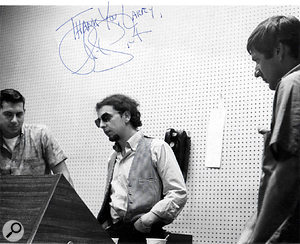 Levine, Spector and Sonny Bono at the desk — signed 'Give thanks you lot Larry' by Spector.Photograph: Ray Avery/Redferns
Non that this was always enough. Spector himself in one case commented "In those days if I couldn't get a drum sound I'd go crazy. I'd go out of my listen, spend five or six hours trying to get a pulsate audio."
Levine concurs: "The drums were the bane of Phil's existence. He'd go along saying, 'In Detroit they've got the drums nailed down and they e'er sound the same.' I could never get them to sound the same. Information technology was always work getting the pulsate audio right: to get it sounding like information technology was coming from Hal and not just a roomy sound. That depended a lot on what key the other musicians were playing in. For instance, if the audio-visual guitars were playing a lot of open up strings, their audio would be stronger so there would be less leakage in their microphones, whereas the opposite would be true if they were playing in a cardinal where the sound wasn't as strident. It was a precarious balance, and Hal and Earl and all the guys who played drums were always really cooperative if I asked them to tone it downwards a piddling bit.
"You lot see, I never wanted all the bleed between instruments — I had it, only I never wanted it — and since I had to live with it, that meant manipulating other things to lessen the effect; bringing the guitars up just a pilus and the drums downwards just a hair so that information technology didn't sound like information technology was haemorrhage. If they had to change something then I had to change something. If I needed more mic inputs, I'd often tie the acoustic guitars together considering they gave the sound office of its structure and didn't need to exist heard individually. They were merely some of the bricks in the wall, so to speak, and I could therefore get away with doing that, although I too remember one time when I ran out of microphone inputs and one of the audio-visual guitars had a mic that wasn't plugged in. I said to Phil 'You know, we're not hearing him. You may also transport him home,' and he said 'No, it sounds right. He stays.' There was no way that audio-visual guitar could be heard without a microphone."
42 Times Over
But what of the widely reported paradigm of Spector as mad dictator, relentlessly working his musicians across the bespeak of burnout and refusing to given them fifty-fifty a few minutes' break? Levine insists this is inaccurate.
"It wasn't because he was a taskmaster, merely he only felt that if the guys moved they'd shift the microphones and we'd never get them back to the same exact position," he says. "The sound depended on that, so he hated to give breaks, and he'd try to put this off every bit much equally he could. Even so, he did give them, and his admonition was e'er 'Don't touch the microphones.' That having been said, while he did have a remarkable ear, it was strange because the things that upset him were not necessarily wrong notes. If what was played fitted in with the larger scheme of things, that was OK. He went more for feel. That was the near important thing."
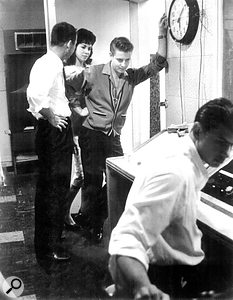 Levine in the control room at Gold Star in the belatedly '50s with Eddie Cochran, his fianceé Sharon Sheeley and his manager, Jerry Capeheart.Photo: Ray Avery/Redferns
According to legend, 42 run-throughs took place over the grade of four hours before Spector gave Levine the become-ahead to coil tape on 'Be My Babe', but this was adequately conventional for a homo who used the studio as in musical instrument in itself.
"We almost never got into rolling record earlier we got into overtime on a session," the engineer confirms, and this in turn raises the question every bit to whether the pursuit of excellence might take resulted in the musicians reaching a peak and then becoming frazzled.
"I often had a hunch that Phil needed that to happen," Levine says. "All of them were really peachy musicians, and what he didn't desire was whatsoever individuality to show. They had to fit into the overall picture, whereas until they got tired enough they might be playing their hearts out. Now, I don't know if that's true or not, but information technology seemed that way."
The line-up inverse from session to session, yet the layout inside the live area normally remained the same. Looking out through the control room glass, Levine would see Blaine taking care of the main drum office and his young man drummer playing figures right aslope him on the far-left side, while the keyboards were on the about-left side — one thousand piano, upright piano and electric piano, unremarkably recorded with Electro-phonation RE15s. The revolving door of percussionists was arranged along the dorsum wall, and so to the far-right there was the horn section, miked with RCA 44s on the two trumpets and 2 trombones, as well equally RE15s on the three saxophones. Centre-right were the woodwind players, while near-right were the bass guitarists, their amps each close-miked, often with Shure SM57s. Lastly, in the middle of the room, facing toward the drums, were the audio-visual guitars, again mostly recorded with RE15s.
"I experimented a lot," Levine asserts. "I would become in and fix the studio, and and then subsequently the session I'd ask the guys if they could hear each other well and how it was working in there. According to their feedback, I might then endeavor some other setup the next fourth dimension. Basically, I discovered things that didn't work and I found out why they didn't piece of work — one thing I found out was that the drummers need to be placed up confronting the wall, otherwise they don't hear themselves and they play too loud trying to hear themselves. I retrieve that'southward true with most instruments. If there's a wall behind them, the musicians tin hear themselves.
"In that location were always more than 20 people jammed into that room when Phil was doing a session, but that wasn't the worst. The worst was when I worked with Herb Alpert on 'This Guy's In Honey With You' and [pianist/co-composer] Burt Bacharach, who'd never been in the studio before, came in for the live recording with all the string players and couldn't believe what he saw. Of course, the piano was right at the dorsum of the room, and he said he had to step over people to get at that place. That was the most crowded information technology ever got, merely information technology was also crowded for Phil'due south stuff, and I found out that the more people you put in the room, the better the sound is. The bodies provide dampening."
 Spector and Bono on the studio floor at Gold Star playing percussion.Photograph: Ray Avery/Redferns
Vocals
Later on the 'Be My Infant' rhythm track had been recorded inside a mean solar day sans guide vocal, it was time for Ronnie Bennett to practice her matter. In her 1990 autobiography (naturally titled later on the song), the vocaliser recalled that she and Spector had spent several weeks rehearsing the number prior to her flying out to Gold Star — she was the only Ronette on the session — and that information technology and then took virtually three days to really capture her operation.
"I was then shy that I'd exercise all my vocal rehearsals in the studio's ladies' room, because I loved the sound I got in at that place," she wrote. "People talk about how groovy the echo bedchamber was at Gold Star, but they never heard the sound in that ladies' room... That'southward where all the trivial 'whoa-ohs' and 'oh-oh-oh-ohs' you hear on my records
were born."
The following year, the liner notes of the anthology Presenting The Fabulous Ronettes Featuring Veronica included Levine's own recollection: "When I get-go met the Ronettes I didn't recall they were going to be a very good group. Phil had said to me 'I found this grouping, they're skillful looking, but they don't sing likewise well.' So I said 'Well, why bother?' He said 'I kind of promised their mother.'"
Now Levine says: "We didn't take to piece of work hard to get Ronnie's performance, just we had to work hard to satisfy Phil. He'd spend an inordinate amount of fourth dimension working on each section and playing it dorsum earlier moving on to the next i, and that was very hard for the singers. I always commiserated because Phil didn't pay likewise much attention to them. He treated them equally if they were another instrument. I mean, they weren't ill-treated, they were but ignored."
Ronnie'due south retention of the 'Exist My Baby' sessions corresponded with Levine'southward observation. Continuing behind a big music stand up, the future Mrs Spector would sing into a Neumann U47 and then, after completing a accept, peer through the command room window in order to estimate the reactions of both producer and engineer.
"If they were looking down and fooling with the knobs, I'd know I had to exercise it again," she recalled. "But if I saw they were laughing and yelling 'All right!' or 'Damn, that little girl can really sing!' I'd know we had a have. Since my arroyo to each vocal was completely up to me, watching Phil and Larry react afterward was the just real feedback I always got."
Spector At His All-time: 'Yous've Lost That Lovin' Feelin'
For Larry Levine, the zenith of Phil Spector'southward production career, and near perfect encapsulation of his Wall of Sound, was the Righteous Brothers' 'You've Lost That Lovin' Feelin'. Written by Spector, Barry Mann and Cynthia Weil, and recorded in November 1964, the track ran to iii:46, and when the producer refused to shorten it to appease radio DJs, he instead ensured that the running fourth dimension printed on the label was '3:05'.
"The emotion on that recording ran the gamut," says Levine, who the post-obit twelvemonth won a Grammy for his engineering of Herb Alpert & the Tijuana Brass'south A Taste Of Honey, before taking upwardly with a heavily Spector-influenced genius in the form of Embankment Male child Brian Wilson and technology much of Pet Sounds and Smile. "Again, Phil took what was happening at the moment and totally changed the content, but as he'd done with 'Zippo-A-Dee-Doo-Dah'. His biggest fear was that it was the only one of his songs that didn't have a backbeat. It was a existent deviation from annihilation else that he'd washed, it had all of these emotional cease-starts and he wasn't sure that it was going to work. However, it was certainly the greatest record I ever worked on, and the reason I say that instead of 'River Deep, Mountain Loftier' is that Phil kept reaching to go across where he had been previously. I call up he got to that point before the technology was able to continue up with him on 'River Deep', whereas 'You've Lost That Lovin' Feelin'' achieved what he really wanted to hear.
"When 'River Deep' failed [in the Us] he was really disappointed with the critics. Anybody wanted to see him fail, because he had this reputation for being stuck-up, and that isn't who he is when you go to know him. I love Phil. There's no dubiousness he's never been your run-of-the-mill type of guy, and I always admired him and his abilities, but unfortunately I think he kind of grew into what he was depicted every bit being."
Altogether Now!
Next on the calendar were the bankroll vocals, and according to Ronnie these were the most fun on the entire session, considering everyone was invited to join in.
"If you lot were continuing around and could carry a melody, y'all were a background singer in Phil'south Wall of Sound," she wrote. "And everybody Phil knew seemed to show up the day we did backgrounds for 'Be My Baby'. Darlene Love was there, and we had Fanita James from the Blossoms, Bobby Sheen from Bob B. Soxx and the Blue Jeans, Nino Tempo, Sonny Bono — who was Phil's gofer in those days — and Sonny'southward girlfriend, who was a gawky teenager named Cher."
Gawky, perhaps, but her vocal traits were already in place. "We'd have to keep backing Cher upward because her vocalisation came through stronger than whatsoever of the others," Levine states.
Meanwhile, as well of note is the fact that the 'Be My Baby' sessions represented the first occasion on which Phil Spector utilised a total orchestra string department at Aureate Star.
"I honey those strings, specially at the end," Levine remarks. "They made me weep when I was mixing... I was always mixing for Phil's ears before we got to the final mix. You know, a lot of times when y'all've recorded something y'all can just sit down back and play it for the producer, but that was never the case with Phil. When I played something back for him I also had to be mixing information technology, and that was a lot of work.
"Still, the final mix of the rhythm track, the strings and the voices was great fun, and I really approved of how nosotros did information technology. Phil would get out the room and I would mix until I had something I liked, and so I'd telephone call him back in and play it for him and he would critique it: 'The strings should come up here,' or 'They should come in there,' and then he'd get out again. I would mix according to those criteria, and when I had what I felt was good I'd call him in, we'd repeat the whole process, and what we'd accomplish out of that was that I'd be able to mix without someone looking over my shoulder. I was mixing what I wanted to hear rather than what I thought somebody else wanted to hear, and then everytime Phil listened it would exist with clean ears. That was a great way to mix."
The Wall Of Sound
All the same, given the aforementioned mass line-upward of musicians, was the Wall of Audio really in the room when the rail was being performed?
"Aye, but you wouldn't have heard information technology if you walked in while nosotros were recording information technology," comes the answer. "You lot see, whenever someone came into the command room, to impress them Phil would immediately raise the level of the monitors. Of form, we'd been listening for hours, so our ears would kind of re-melody to handle that, but I know that for people who came in at that level all they'd hear was a roar. That was until they were in there for a menses of fourth dimension. So their ears would arrange and at that bespeak they'd hear the Wall. For me, it was amazing to hear things from the outset, starting with the guitars and gradually building upward to the Wall of Sound. That was a unique experience."
What Instruments Are Used in Be My Baby
Source: https://www.soundonsound.com/techniques/classic-tracks-ronettes-be-my-baby
0 Response to "What Instruments Are Used in Be My Baby"
Post a Comment